
Douglas County Probate Records Scope
Douglas County Probate Court handles estates and wills, guardianships and conservatorships, birth certificates, death certificates, marriage records, marriage licenses, Georgia weapons carry licenses, and certain involuntary-treatment matters. The court is separate from Superior Court and State Court. That matters because a Probate Court estate file or guardianship case will not be searched the same way as a felony, divorce, traffic citation, or civil lawsuit.
The Probate Court is led by Judge Valerie V. Vie and is located at 8700 Hospital Drive, 3rd Floor, Judicial Side, Douglasville, GA 30134. The office phone is 770-920-7249, fax is 770-920-7381, and posted hours are 8:00 a.m. to 5:00 p.m. Monday through Friday. The court's own mission statement emphasizes fair, timely, courteous service, but its forms page also warns that local forms and information do not guarantee a court outcome.
The Douglas County Estates and Wills source documents estate and will access.
That local page is the strongest source for Douglas County estate record coverage, mail filing, creditor claims, and will safekeeping.
Douglas County Probate Terms
Probate filings use terms that can make a record search hard if they are not clear. These definitions are practical search terms, not legal advice. They help separate an estate file from a guardianship file, a will safekeeping item from a petition, and a conservatorship from a general vital-record request.
- Testator
- The person who made a will.
- Executor
- The person named to carry out a will and handle estate duties after death.
- Intestate
- A death without a valid will, which changes how heirs and estate administration are handled.
- Guardianship
- A court process for personal decision-making authority for a minor or adult who needs legal protection.
- Conservatorship
- A court process for managing another person's property or financial affairs.
The Douglas County guardianship source explains guardianship and involuntary-treatment filing points.
Guardianship and involuntary-treatment records can include medical or personal details, so they require more care than routine estate indexes.
Search Douglas County Probate Records
Probate Court uses several access channels. Estate records may be searched online from the Estates and Wills page, and the office maintains estate files back to the late 1800s with name indexes for retrieval. Public estate record access is available 8:00 a.m. to 4:30 p.m. Monday through Friday. Marriage records are searched through Georgia Probate Records, while birth, death, and some marriage certificate orders may use the Probate Court vital-record process or Permitium system.
Older Douglas County probate records may require a name-index search rather than a modern case-number search. The estate inquiry process is built around a decedent name, and the court charges a non-refundable research fee per name. That makes spellings, prior married names, and approximate death details useful before a visit or mail request. A will held for safekeeping is also different from an opened estate file, so the search should identify whether the person is living, deceased, or tied to an active estate case.
- Identify whether the record is an estate, will, guardianship, conservatorship, marriage, birth, death, or weapons-carry matter.
- Use the estate search, Georgia Probate Records marriage search, or Permitium vital-record order path if the record type fits an online tool.
- Visit Probate Court during public estate record access hours when the file is older, indexed by name, or not found online.
- For filings, submit signed, verified, fee-ready pleadings by mail when possible, or bring file-ready pleadings in person.
- Call Probate Court before mailing if the amount, form, or eligibility rule is unclear.
The court recommends mail filing for estate matters. If a person cannot mail the filing, the office accepts in-person filings, but the packet must be complete with properly notarized signatures. The office states that no one will be available to help complete the forms. Petitions to probate estates may be filed from 8:00 a.m. to 4:15 p.m.; late filings may be accepted but processed the next business day.
Douglas County Probate Court Contact
Douglas County has one county Probate Court for the probate records covered here. It is not a second clerk page for Superior and State Court case files. Divorce case copies go to the Clerk of Superior Court, and criminal or civil trial-court files use the Clerk of Superior and State Courts. Probate Court handles its own estate, guardianship, licensing, marriage, and vital-record files.
Douglas County Probate Court
Judge: Valerie V. Vie
8700 Hospital Drive, 3rd Floor Judicial Side
Douglasville, GA 30134
770-920-7249
Fax: 770-920-7381
Monday-Friday, 8:00 a.m.-5:00 p.m.
The Douglas County Probate forms source is the local form page for probate filings.
That forms source is important because filing packets must be complete before the court will accept or process them.
Douglas County Probate Fees
Probate fees vary by task. The research identifies estate inquiry, creditor claim, will safekeeping, vital-record, and petition-calculator channels. For petitions, the Probate Court links the Georgia Probate Records fee calculator rather than publishing one flat amount for every estate filing. Mailed pleadings without fees are returned without filing, so fee checks should be confirmed before mailing.
Payment planning matters because Probate Court filing packets must be complete when submitted. The county's estate guidance says mailed pleadings without the required filing fee will be returned, and in-person pleadings should already be notarized and file-ready. Vital-record payments have their own cash or money-order rules, while estate petitions may need the online calculator. A single Probate Court visit can involve more than one fee type if the request includes a petition, certified document, and certificate copy.
| Item | Amount |
|---|---|
| Estate inquiry research fee | $15 non-refundable per name |
| Formal creditor claim against estate | $15 plus $2 per page for recording |
| Will safekeeping | $15 |
| Petition fees | Use Georgia Probate Records petition fee calculator |
| Birth or death certificate | $25 cash or money order, $5 additional same certificate same day |
| Marriage certificate through vital records | $20 cash or money order, $5 additional same certificate same day |
| Mail vital record | Include $1 mailing fee |
The Douglas County vital-record request source supports the certificate fees and local request route.
Vital-record requests sit inside the Probate Court service set, but they follow different requester and certificate rules than estate files.
What Douglas County Probate Records Show
Estate records may show the decedent name, approximate date of death, case number, petition type, will filings, administrator or executor information, creditor claims, notices, inventories, accountings, orders, and distributions. A will held for safekeeping is different from a probated estate file. The research states that a living person may file a will for safekeeping for $15, and only that person or the executor after death can access it.
Guardianship and conservatorship files may show petition allegations, proposed ward information, medical or personal facts, appointment orders, bonds, reports, and court oversight. The guardianship page also states that involuntary-treatment affidavits require at least two witnesses who saw the person within the preceding 48 hours and believe treatment is needed because of mental illness, alcoholism, drug dependency, or drug abuse. The person must be in Douglas County and at least 17; jurisdiction for age 16 and younger is Juvenile Court.
The Douglas County Probate Court Permitium source is the official online vital-record ordering vendor linked by the county.
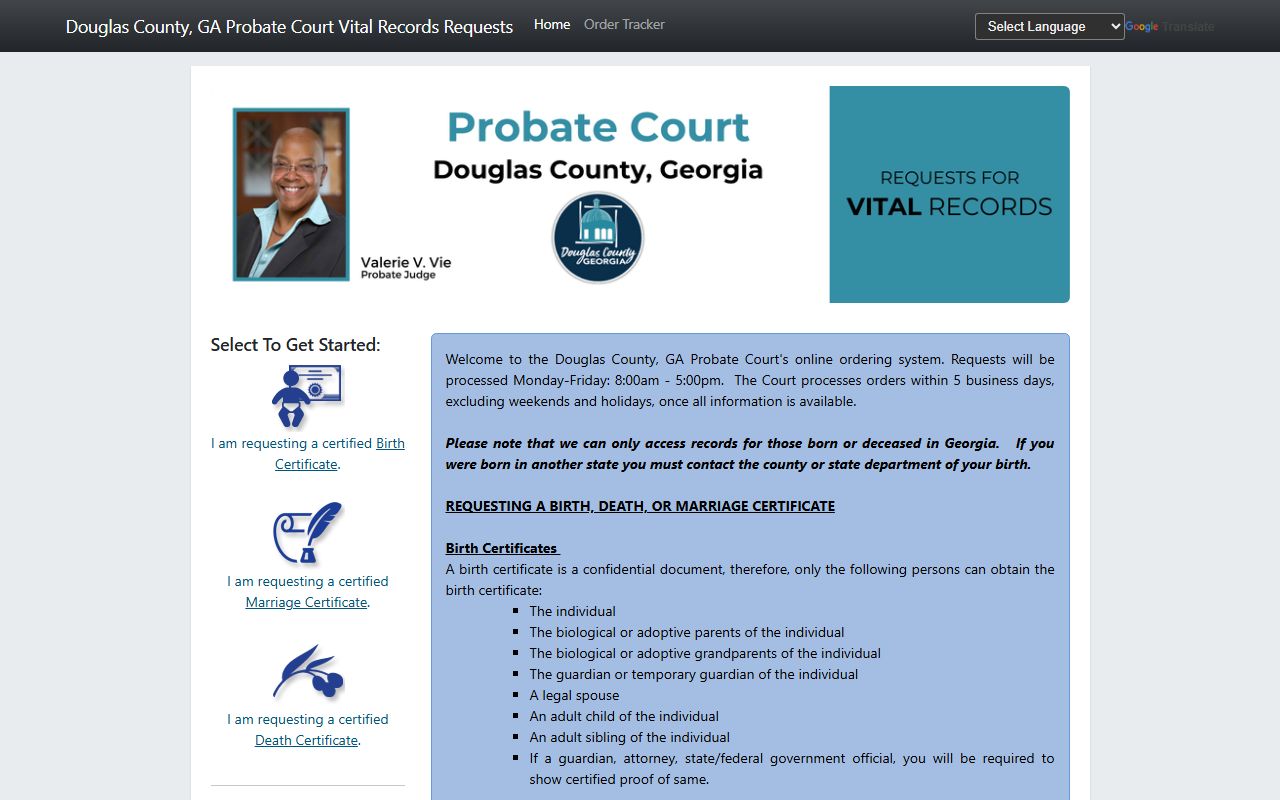
Permitium is useful for eligible vital-record orders, while estate and guardianship records still depend on Probate Court record access rules.
Restricted Douglas County Probate Records
Not all Douglas County Probate Court records are open in the same way. Estate indexes and many estate files may be public, but adoption-related material, minor guardianships, medical information, involuntary-treatment affidavits, personal identifiers, and some vital-record documents may be limited by law or court practice. A public probate record may also have redactions for Social Security numbers, financial account numbers, confidential addresses, or minor identifying details.
Vital-record access is more identity-based than estate access. Birth and death certificates usually require proof that the requester is eligible, while a marriage-record search may be broader through Georgia Probate Records. Guardianship and conservatorship files can include health, capacity, assets, and family details. Those records may require court review or a specific relationship to the case before copies are released, even when the case name or docket exists in the Probate Court system.
The Georgia Probate Records system supports probate functions such as records and fee tools linked by the county.

The statewide probate platform helps with certain online tasks, but access to restricted Douglas County probate material still depends on the local court.
Note: For probate records that involve health, minors, or sealed matters, call Probate Court before assuming the file can be inspected online.