
Douglas County Superior Court Overview
Georgia does not use the term district court for its main county trial court. In Douglas County, Superior Court is the general-jurisdiction court for felony criminal cases, divorces, child custody, title-to-land disputes, equity matters such as injunctions and protective orders, and other major civil disputes. The State Court is a separate trial court for misdemeanors, traffic citations, and State Court civil matters. That split is important for record searches because the case type determines which court generated the file.
The Douglas County courthouse complex is at 8700 Hospital Drive, Douglasville, GA 30134. The same complex houses Superior Court judges, the Clerk of Superior and State Courts, State Court, Probate Court, Magistrate Court, the District Attorney, and the Public Defender. Visitors should plan for courthouse security screening before reaching court offices or courtrooms, a point repeated in county office materials.
For record access, the practical question is whether Superior Court had jurisdiction over the case. Felony charges, divorce decrees, custody orders, title-to-land disputes, injunctions, and major civil judgments point to Superior Court. Misdemeanor cases, county traffic citations, small claims, dispossessory cases, estate files, and city tickets point elsewhere. A search for "Douglas County District Court" should therefore be translated into a Douglas County Superior Court search only when the case type fits that jurisdiction.
The Chief Superior Court source identifies the current chief judge page used for this court profile.
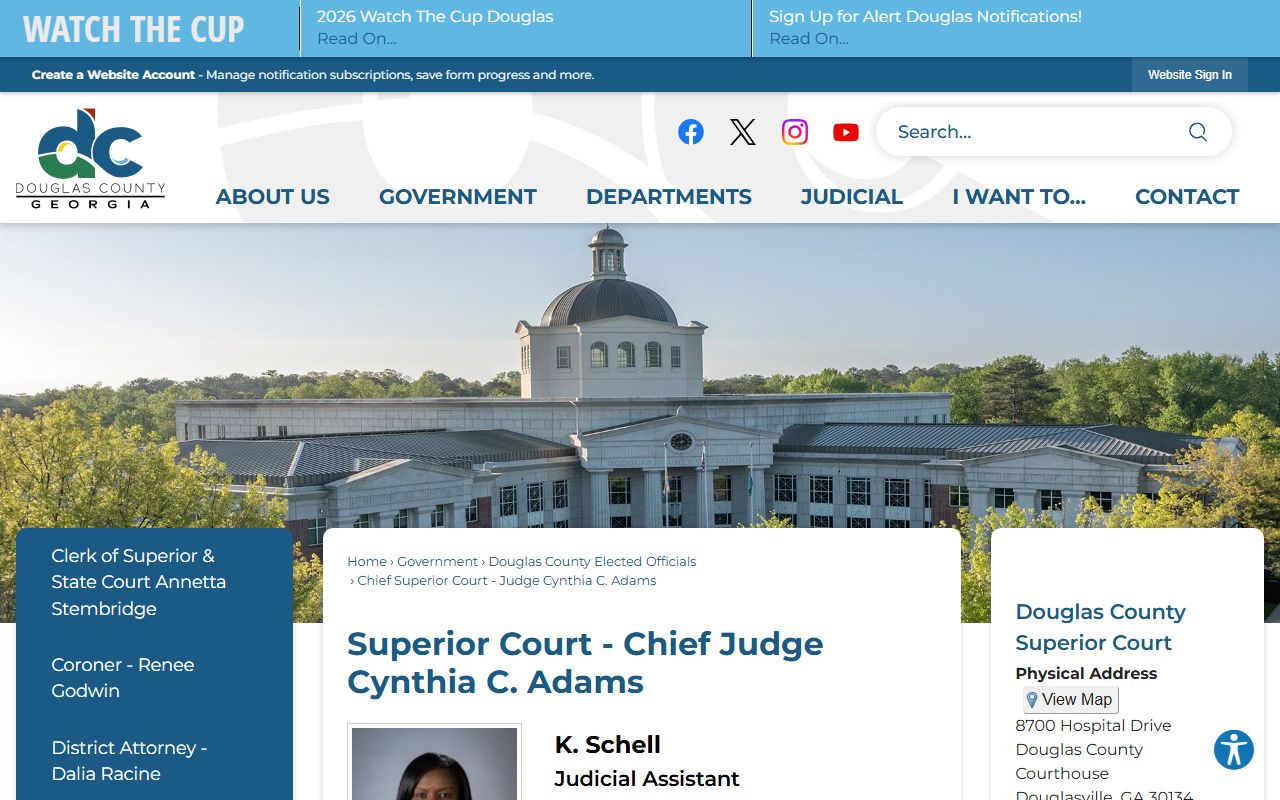
That local court source anchors the Superior Court page to the actual Douglas County judge and courthouse structure.
Douglas County Superior Court Judges
Douglas County Superior Court is not organized as numbered district courts in the Texas sense. The local trial-court table is best read by judge and court class. The research identifies four Superior Court judges and several related county trial courts that affect record routing.
| Court / Judge | Type | Address | Phone |
|---|---|---|---|
| Superior Court, Chief Judge Cynthia C. Adams | Felony, divorce, custody, land, equity, civil | 8700 Hospital Drive, Douglasville, GA 30134 | 770-920-7265 |
| Superior Court, Judge Deah B. Warren | Felony, divorce, custody, land, equity, civil; Felony Drug Court division | 8700 Hospital Drive, Douglasville, GA 30134 | 770-920-7227 |
| Superior Court, Judge Lauren Wallace | Felony, domestic relations, land disputes, civil; specialty-court roles | 8700 Hospital Drive, Douglasville, GA 30134 | County court directory |
| Superior Court, Judge James A. Kiger | Superior Court matters | 8700 Hospital Drive, Douglasville, GA 30134 | Directory/court page |
The Judge Deah B. Warren source documents felony, divorce, custody, land, equity, and civil jurisdiction details.
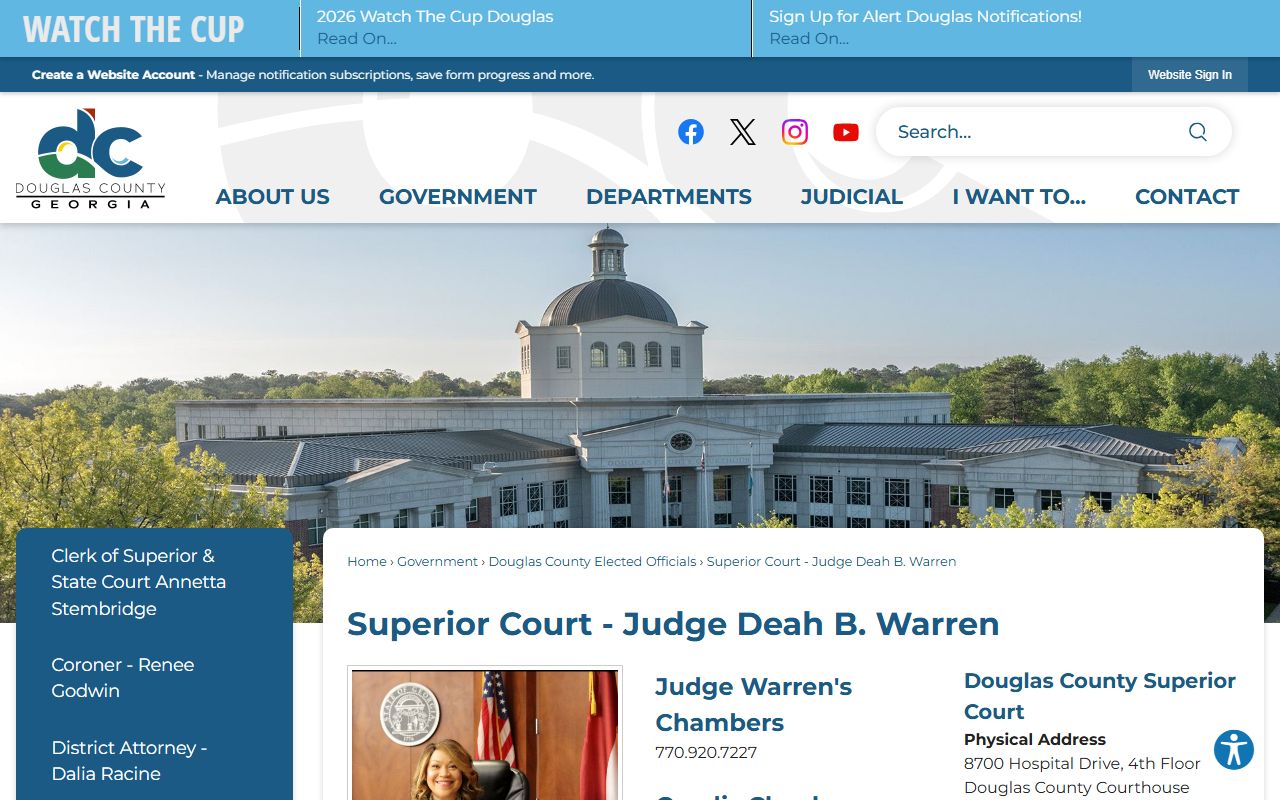
Judge-specific pages help connect broad Superior Court jurisdiction to the actual Douglas County courtrooms that hear those matters.
Superior Court vs Lower Courts
Georgia's lower-court map is different from states that use county courts and justice courts. Douglas County has State Court, Magistrate Court, Probate Court, Juvenile Court, and municipal courts. These courts can all create records, but they do not all feed into the same search tool or clerk office.
| Point | Superior Court | State Court | Magistrate / Municipal Court |
|---|---|---|---|
| Main records | Felony, divorce, custody, land, equity, major civil | Misdemeanor, county traffic, State Court civil | Small claims, evictions, warrants, city traffic, ordinances |
| Clerk route | Clerk of Superior and State Courts | Clerk of Superior and State Courts, State Court side | Magistrate clerk or city municipal court |
| Online access | County WebSearch when available | County WebSearch or PayYourTix for traffic | County WebSearch for some Magistrate civil; city portals for municipal tickets |
| Common mistake | Searching "district court" instead of Superior Court | Assuming misdemeanor cases are Superior Court files | Assuming a city ticket appears in county State Court |
The Judge Lauren Wallace source is another assigned Superior Court image source.
Specialty-court roles on judge pages show why a single criminal case may include both a public case file and program-related limits.
Douglas County Case Flow
A felony case may touch more than one Douglas County court before it becomes a mature Superior Court record. Magistrate Court can handle bond hearings, preliminary hearings, and some pre-arrest warrant hearings. The District Attorney prosecutes felony offenses in Superior Court. Once the Superior Court case opens, the clerk's file may show charges, arraignment, pleas, motions, hearings, disposition, sentence, and appeal activity.
Felony flow: Arrest or warrant › Magistrate first appearance or bond hearing › District Attorney review › indictment or accusation route › Superior Court arraignment › pretrial motions › plea or trial › sentencing › appeal.
Civil and family flow: complaint or petition filed › service › answer › motions or temporary orders › discovery or mediation › hearing or trial › judgment, decree, or order › post-judgment filings or appeal.
The clerk's docket can lag behind real-world events when filings, hearings, or sentencing paperwork are still being processed. A bond hearing may appear before the Superior Court case is fully developed. A divorce or custody matter may have temporary orders before final judgment. A civil case may have service returns, motions, and continuances before trial. For certified proof, use the final filed order or judgment rather than a calendar entry alone.
The Judge James A. Kiger source is the fourth local Superior Court judge image source.
Using judge and court-class sources together helps prevent a Douglas County Superior Court search from drifting into the wrong court office.
Civil, Family, and Criminal Divisions
Superior Court's criminal side handles felony cases. Those records may include warrants, indictments or accusations, arraignment calendars, pleas, motions, bond orders, dispositions, sentences, probation terms, fines, costs, attorney entries, and appeal filings. Public calendars in the research showed fields such as case number, case caption, filing date, hearing type, judge, incarceration date, charges, felony or misdemeanor labels, District Attorney, and defense attorney.
The family and domestic side handles divorces, child custody, and related domestic relations matters. A divorce file may include the complaint, answer, service returns, temporary orders, child support worksheet, parenting plan, settlement agreement, final judgment and decree, and post-decree motions. Equity matters such as injunctions and protective orders are also part of Superior Court jurisdiction, but sensitive filings can be sealed or redacted.
For broad court-record searching, use Douglas County court records as the general route and the Clerk of Superior and State Courts for certified copies.
Judicial Circuit / District
Douglas County Superior Court is the primary trial court for general-jurisdiction records because Georgia's trial-level system includes Superior, State, Juvenile, Probate, Magistrate, Municipal, and State-wide Business Court classes rather than a county district-court model. Appeals may go to the Court of Appeals of Georgia, with discretionary or direct review in the Supreme Court of Georgia depending on the case type.
Douglas County also has localized specialty-court context. Judge Deah B. Warren presides over a division of the county's Felony Drug Court. Judge Lauren Wallace's page identifies Veterans Court, Opioid Court, and the Daily Reporting Center roles. State Court Judge Brian K. Fortner oversees a Moderate Risk DUI and Drug Accountability Court track. These programs may affect sentencing or supervision, but treatment details and compliance records are not always public case-search material.
Appeal routing depends on the issue. Many Superior Court orders may be reviewed by the Court of Appeals of Georgia, while certain constitutional, election, death penalty, or other designated matters may involve the Supreme Court of Georgia. That appellate path does not move the local file out of Douglas County for ordinary copy requests. The trial-court record still begins with the Douglas County Clerk of Superior and State Courts, even if later appellate filings exist.
The Governor appointment source for Judge Deah Warren is the final assigned image source for this page.
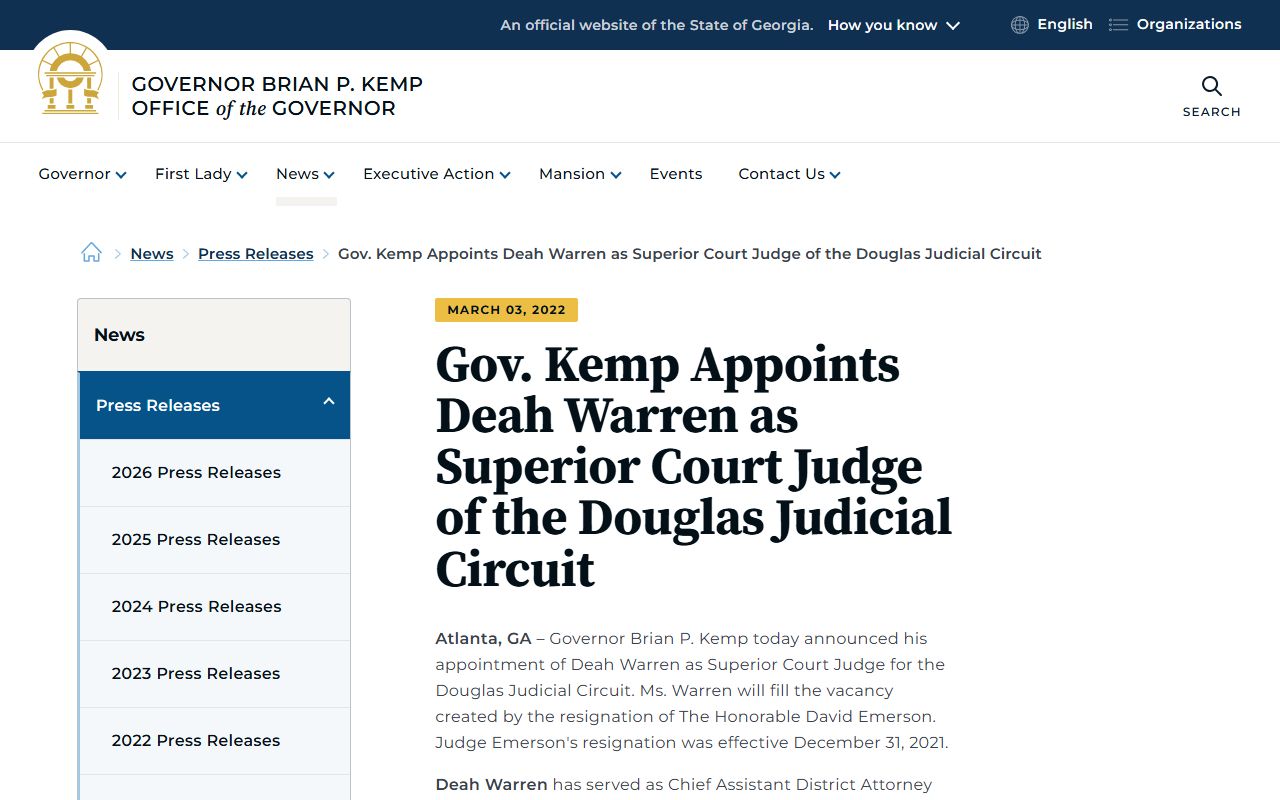
Appointment and judge-history sources add local context without changing where Superior Court records are requested.
Magistrate and Lower Courts
Magistrate Court is critical in Douglas County for early criminal procedure and lower-value civil matters. It handles claims under $15,000, dispossessory actions, garnishments, personal property foreclosure actions, bond hearings, preliminary hearings, and pre-arrest warrant hearings. Its office is also at 8700 Hospital Drive, and the listed phone is 770-920-7540. Magistrate civil records may be linked through the same courts.dcga.us host, but the filing and hearing rules are separate.
Municipal courts must be checked when a case starts with a city police department. Douglasville Municipal Court handles city traffic citations, misdemeanor state law violations, ordinance violations, code compliance matters, animal control matters, probation violations, dockets, fines, and fees. Villa Rica Municipal Court handles city ordinance violations and state traffic offenses, including routine traffic, DUI, underage possession or consumption, marijuana under one ounce, and misdemeanor shoplifting. Austell Municipal Court handles traffic, local ordinance, misdemeanor state law violations, dockets, and fines.
Note: If a search for a Douglas County Superior Court record fails, confirm the case was not filed in State Court, Magistrate Court, Probate Court, or a city municipal court.